
Services
Foot Orthotics
Reviewed by Anureet Selach, Podiatrist · Australian Podiatry Association · Registered with AHPRA
Last updated
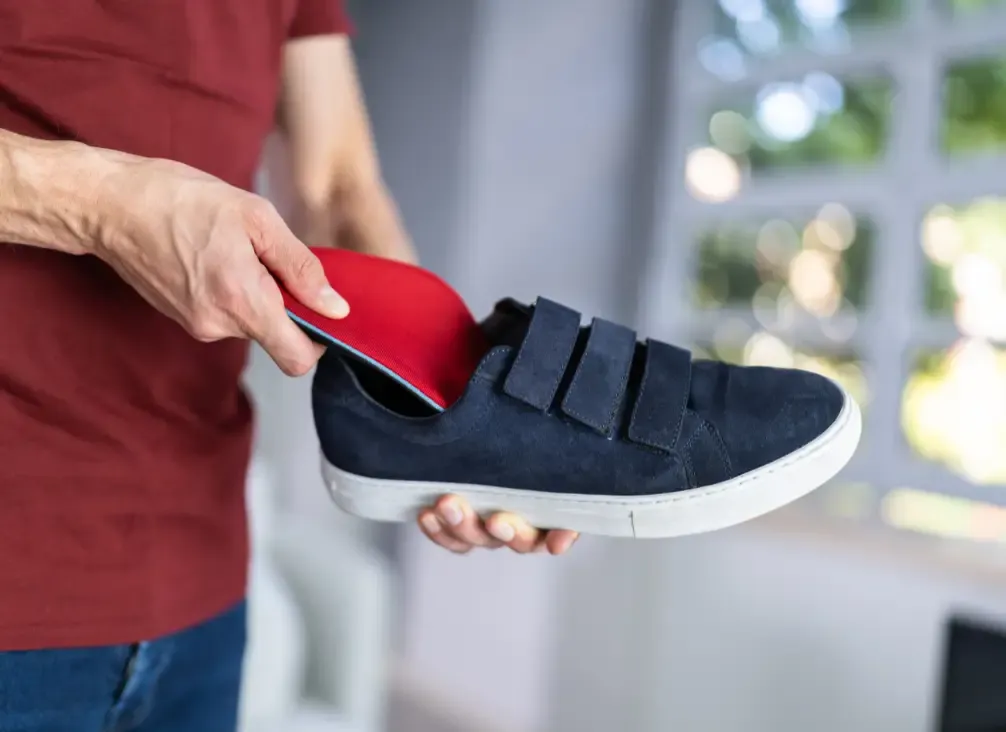
If your first steps in the morning feel like walking on hot coals, that’s worth having looked at. Pain that’s worst after rest and eases once you get moving is one of the clearest patterns in podiatry, and it usually points at how your foot is loading rather than at the sore spot itself.
Orthotics are one of the ways your podiatrist can change that loading. They’re not the only way, and this page is honest about when they’re the wrong answer.
What an orthotic actually does
An orthotic is a device that sits in your shoe and changes how force travels through your foot. It isn’t an arch cushion. A cushioned insole from a pharmacy makes a shoe feel softer; a prescribed orthotic redistributes pressure and alters alignment through the whole lower limb.
The two patterns it’s most often used for:
- Overpronation — the arch flattens and the foot and ankle roll inward.
- Supination — less common, the opposite. High arches, foot rolling outward.
Both put load somewhere it wasn’t designed to go, and that load doesn’t stop at the foot. Knees, hips and lower back are all downstream of it.
What that can help with
Your podiatrist may consider orthotics as part of managing:
- Heel pain and arch strain
- Shin splints
- Knee and lower back pain that tracks back to foot mechanics
- Postural imbalance
- Aching or fatigue from long periods standing or walking
Three types, three price points
| Type | What it is | Item code | Fee |
|---|---|---|---|
| Custom | Individually made to the contours of your foot from a scan. Maximum control and durability, and it can be made up for different shoe types. | 221 | $500 |
| Semi-modified | A quality prefabricated base, then adjusted by your podiatrist to your foot shape and your condition. | 267 | $300 |
| Modified off-the-shelf | Podiatrist-designed, ready to wear, slightly adjusted for fit. Good for growing children and short-term use. | 240 | $98 |
The orthotic scan that precedes a custom or semi-custom device is $140 (item 301) and is charged separately. Optional top covers are $50 each (item 381), and a review of orthotics already prescribed is no charge.
Even the entry-level option is a different thing from a supermarket insole — it’s designed by podiatrists and adjusted to your foot. It’s the durability that differs, not the intent.
Children are approached differently
Orthotics in children are prescribed conservatively and late rather than early. Your podiatrist will work through footwear, activity and strengthening first, and will only prescribe a device when the assessment says one is needed.
Under three or four, orthotics are rarely appropriate at all unless symptoms are severe or there’s an underlying medical condition — prescribing too early can interfere with the way a child’s gait develops naturally. Leaving a genuine problem too long has its own cost, which is why the assessment matters more than the rule of thumb.
Where a child is assessed, it’s a full lower-limb examination: biomechanical assessment and gait analysis, looking for mechanics, gait patterns or muscle imbalances behind the discomfort. Conditions that may be managed with a device include flat feet, in-toeing and out-toeing, knock knees and bow legs, Sever’s disease, Osgood-Schlatter disease, growing pains, and heel, ankle or knee pain.
Children’s devices are reviewed every three to six months, because a growing foot changes and a device that fitted in March may not in September.
What the appointment involves
A biomechanical foot assessment (item 118, $150) looks at how your foot is built and how it moves — standing, walking, and through range of motion. Gait analysis is part of it.
If a device is indicated, your podiatrist will talk through which of the three types suits your situation and your budget before anything is scanned or ordered. If one isn’t indicated, they’ll say so.
Frequently asked questions
How much do orthotics cost?
Custom orthotics are $500 a pair (item 221), semi-custom $300 (item 267), and modified off-the-shelf $98 (item 240). The scan that precedes them is $140 (item 301) and isn't included in those prices. A review of orthotics already prescribed is no charge. Full list on the fees page.
Will my health fund cover them?
Most extras policies include orthotics, but the annual limit and the waiting period vary a lot between funds. Quote the item code above to your fund and they'll tell you your exact rebate. We claim on the spot through HICAPS, so you pay the gap rather than the full amount.
Do I need custom orthotics or will off-the-shelf do?
It depends on what the assessment finds. Plenty of people do well on a modified prefabricated device, and it costs a fifth of a custom pair. Complex biomechanics, a specific sporting demand, or a device that has to work in several types of shoe are where custom earns its price. Your podiatrist will tell you which applies before you commit to anything.
Does my child need orthotics?
Usually not, and that's the honest answer. Footwear changes and strengthening work come first, and children under three or four are rarely prescribed orthotics at all unless symptoms are severe or there's an underlying condition. Prescribing too early can interfere with how a child's gait develops.
How long do they last?
A custom pair typically lasts several years for an adult. Children grow out of theirs, which is why reviews are set every three to six months while they're still growing.
Ready to book?
Appointments Monday to Saturday, with confirmation by SMS.