
Conditions
Osgood-Schlatter Disease
Reviewed by Anureet Selach, Podiatrist · Australian Podiatry Association · Registered with AHPRA
Last updated
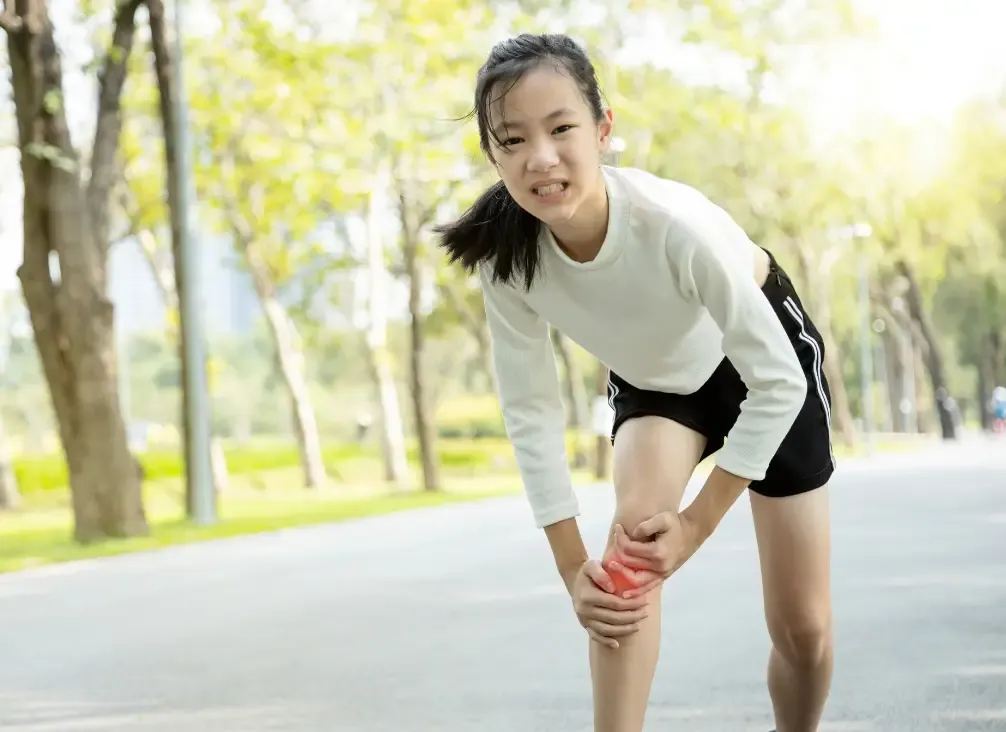
Hearing “Osgood-Schlatter disease” for the first time sounds worse than it is. It’s common, it’s self-limiting, and with sensible management most children come through it with no lasting problem.
It affects active children and adolescents during growth spurts — most often boys aged 11 to 15 and girls aged 8 to 13 — particularly those playing high-impact sport.
What it is
Also called tibial tubercle apophysitis. There’s a growth plate at the top of the shinbone, just below the kneecap, where the tendon from the quadriceps attaches. When the quadriceps repeatedly pulls on that unfused growth plate during a period of rapid growth, it becomes irritated and painful.
In more significant cases that traction produces swelling and microfractures at the site.
Signs
- Pain and tenderness just below the kneecap
- Swelling, or a visible bump on the shin
- Worse with running, jumping, stairs and kneeling
- Limping, or avoiding activity
- Pain on direct pressure — kneeling is often the giveaway
- One or both legs; roughly 20 to 30% of cases affect both
Why podiatry
Everything the knee absorbs travels up through the foot and ankle first. How a child’s foot loads, how much range their ankle has, and how they land all change the traction on that growth plate.
Your podiatrist will assess the lower limb as a whole — foot mechanics, ankle range, quadriceps and hamstring flexibility, and gait — then manage it with:
- Load management. Reducing the aggravating activities for a period rather than stopping sport entirely.
- Stretching and strengthening, particularly quadriceps and hamstring flexibility, which reduces the pull on the growth plate.
- Footwear and cushioning to reduce impact reaching the knee.
- Orthotics where foot mechanics are adding to the load.
- Shockwave therapy in cases that haven’t responded — Osgood-Schlatter is the recognised exception to shockwave not being used under 18.
What to expect
Symptoms usually settle over weeks to months. The condition resolves fully when the growth plate fuses, though it can flare again during a later growth spurt before then.
The bump often stays. It’s painless, and it doesn’t mean anything is still wrong.
Frequently asked questions
Will the bump go away?
The pain does. The bump often doesn't — a prominence at the top of the shin frequently remains into adulthood, and it's painless and harmless. It's a cosmetic remnant, not an ongoing problem.
Why is a podiatrist looking at a knee?
Because the load reaching the knee comes up through the foot and ankle. Foot mechanics, ankle range and how a child lands change how much traction the quadriceps puts on that growth plate. Treating the knee without looking at what's underneath it misses part of the picture.
Does my child have to stop sport?
Rarely completely. Load is reduced rather than removed, and the activities that hurt most — deep knee bends, jumping, kneeling, stairs — are modified first. Total rest deconditions the leg and the pain returns on the way back.
How long does it take?
Symptoms typically settle over weeks to months with the right management, and the condition resolves fully once the growth plate fuses. It can flare again during a subsequent growth spurt until then.
Is shockwave therapy used for this?
It can be. Osgood-Schlatter is the one exception to the rule that shockwave therapy isn't used under 18, and it's considered for cases that haven't responded to load management and strengthening.
Ready to book?
Appointments Monday to Saturday, with confirmation by SMS.