
Conditions
Cracked Heels
Reviewed by Anureet Selach, Podiatrist · Australian Podiatry Association · Registered with AHPRA
Last updated
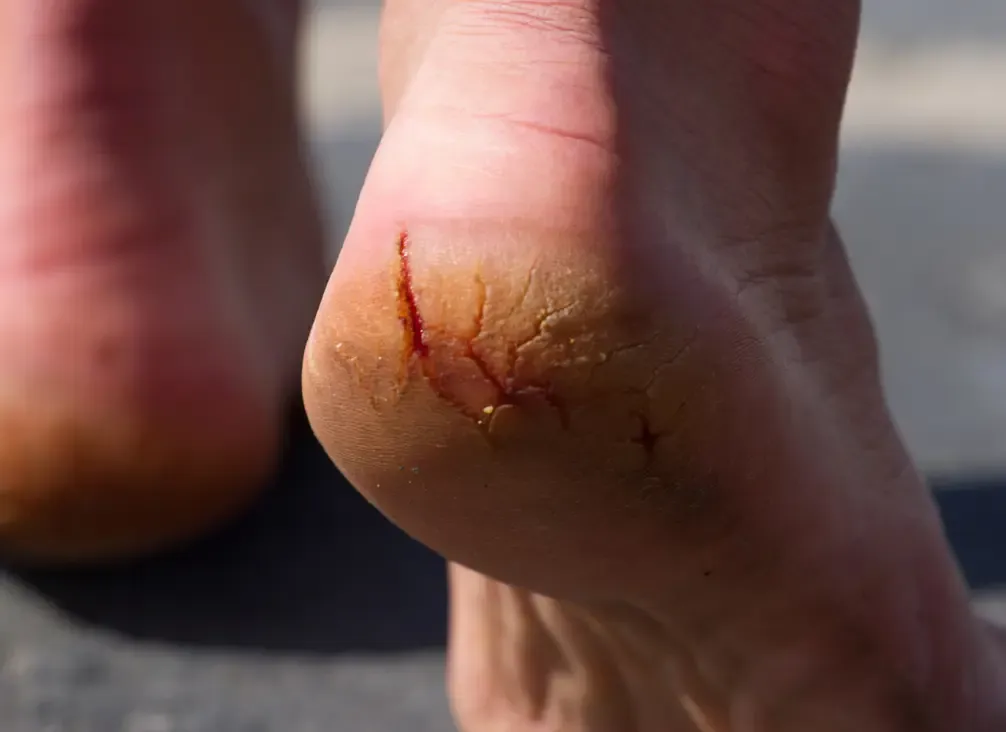
Hard, dry skin around the rim of the heel. A yellowish thickened edge. Splits that catch on your socks and, at their worst, open far enough to bleed and to make the first steps of the morning genuinely painful.
Cracked heels are a mechanical problem wearing a skincare disguise. The cracks are not caused by dryness alone. They form where stiff, thickened, under-hydrated skin is stretched sideways every time you take a step, and the tissue fails along the line of greatest strain.
Why the heel rather than anywhere else
Every time the heel strikes the ground, the fat pad beneath it spreads outward and the skin at the rim has to expand with it. Supple skin does that without complaint. Skin that has thickened into callus cannot stretch, so it splits.
Which explains the factors that keep coming up:
- Open-backed footwear. Thongs, slides and backless sandals let the fat pad spread further with every step. Very common here in summer.
- Standing all day, especially on hard floors.
- Callus, which is the thing that makes the skin unable to stretch.
- Dry skin, from age, low humidity, hot showers or harsh soaps.
- Increased body weight, which increases the spread on each step.
- Medical contributors — diabetes, thyroid disease, and several skin conditions all reduce the skin’s ability to hold moisture.
What an appointment involves
The thickened skin is reduced with a sterile blade. It does not hurt — callus has no nerve supply — and taking the rigid collar off the crack is what allows the split beneath it to close instead of being reopened on the next step.
Then the causes, because debridement on its own is a haircut and the skin will be back:
- Footwear, and specifically what you wear around the house
- Standing surfaces and how long you are on them
- Skin condition, circulation and sensation
- Whether the dryness has a medical driver rather than a cosmetic one
- Whether it is dryness at all, or a fungal infection being moisturised — see athlete’s foot
What you do afterwards, and it is the half that matters
A urea-based cream, usually somewhere between 10 and 25 percent, applied daily to the heels and not between the toes. Urea both draws water into the skin and softens the keratin, which ordinary body lotion does not do. This is the single most effective thing available and it needs to be daily, not occasional.
Alongside it: file gently after showering rather than aggressively once a month, close in the back of your shoes where you can, and where a callus is rebuilding under pressure, deal with the pressure. A cushioned heel cup or a device that redistributes load can be part of that.
When a crack is not a cosmetic issue
⚠ If you have diabetes or reduced circulation, a heel fissure is a break in the skin and should be treated as one. It is a direct route for bacteria into tissue with a limited ability to clear an infection, and heel ulcers are among the harder ones to heal because you cannot easily stop standing on them.
Do not file, cut or treat these at home. Book a diabetic foot assessment.
For anyone, a split that is bleeding, weeping, smells, or is surrounded by red, warm, tender skin needs looking at promptly rather than at the next convenient appointment.
Frequently asked questions
Why doesn't ordinary moisturiser work?
Because most body lotions add water to the surface and it evaporates. Callused heel skin needs a urea-based cream — commonly 10 to 25 percent — which draws moisture into the skin and softens the keratin at the same time. That is a different mechanism, and it is why a chemist heel balm often works when a body lotion has done nothing for a year.
Can I just file the hard skin off?
Gentle filing after a shower, on skin that is still slightly damp, is reasonable maintenance and helps. What causes trouble is taking too much off at once or using a blade at home, which leaves the skin thinner than it needs to be and the surface broken. Thick, deeply fissured heels are quicker and safer to have debrided properly.
Is it because I wear thongs?
Often, partly. Open-backed shoes let the heel fat pad spread sideways with every step, which is exactly the force that splits skin already stiff with callus. Melbourne summers and a pair of thongs are a common combination behind a first appointment for this.
How long does it take to settle?
Thick callus reduced at an appointment feels better the same day. Getting the skin back to a state where it stops splitting usually takes a few weeks of daily urea cream, and keeping it there means continuing at a lower frequency rather than stopping. Skin rebuilds callus at the rate the pressure asks it to.
Could it be something other than dry skin?
Sometimes. A fungal infection produces fine scaling that looks like dryness and will not respond to moisturiser. Eczema and psoriasis both affect the heel. And in people with diabetes, dryness is often a sign of autonomic neuropathy affecting sweating rather than a skin care failure.
Ready to book?
Appointments Monday to Saturday, with confirmation by SMS.