
Services
Ingrown Toenail Treatment
Reviewed by Anureet Selach, Podiatrist · Australian Podiatry Association · Registered with AHPRA
Last updated
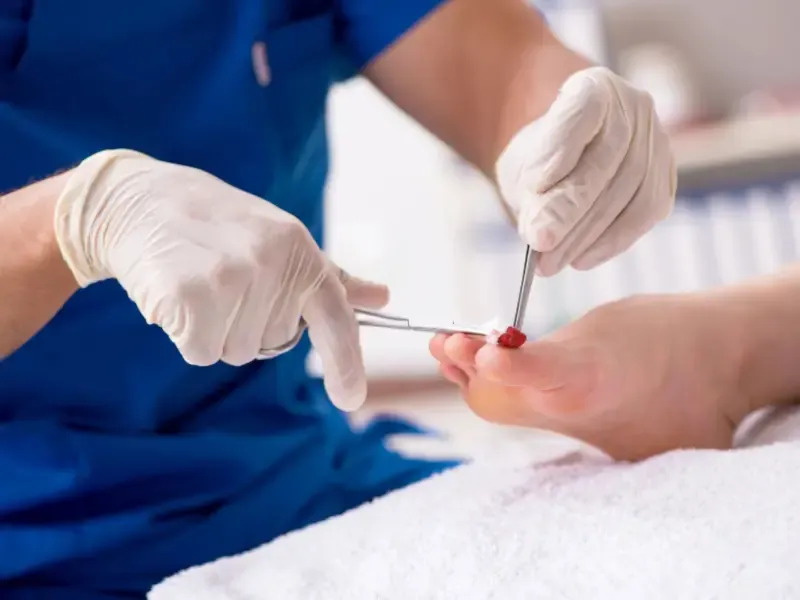
An ingrown toenail happens when the edge of the nail grows into the skin beside it. The big toe is the usual site. It hurts, the skin around it goes red and swollen, and it can become infected.
The causes are mostly mechanical: cutting the nail down the sides rather than straight across, shoes that press on the toe, an injury to the nail, or simply a naturally curved nail shape that was always going to do this.
Mild cases settle at home. Ones that keep coming back, or that hurt enough to change how you walk, generally need something done properly — both to clear the infection risk and to stop the nail deforming over time.
When to have it looked at
Book if you notice:
- Tenderness or swelling beside the nail that isn’t settling
- Redness, or any pus
- Trouble getting a closed shoe on
- A nail that’s thickening or curling into the skin
Early treatment is simpler treatment. It’s also the difference between a conservative visit and a surgical one.
Three routes
1. Conservative care
For mild or early cases, your podiatrist will lift and trim the offending nail edge to take the pressure off, clean and disinfect the area, and advise on footwear and nail-cutting technique so it doesn’t recur. Padding or an orthotic may be used where pressure is part of the cause.
This relieves the episode. It doesn’t change the nail’s shape, so if shape is the underlying problem, expect it back.
2. ONYFIX nail correction
ONYFIX is a non-surgical correction system for curved and involuted nails. A small medical-grade composite strip is bonded across the nail surface and cured with a light, forming a flexible brace. As the nail grows, the brace guides it into a flatter, more natural shape.
- No cutting, no injection, no anaesthetic
- No recovery time — you walk, shower and wear normal shoes immediately
- Suitable for most people, including those with diabetes or reduced circulation, because there’s no wound
- It addresses the shape, so it targets the cause rather than the episode
It works over months rather than in one visit, because it works with the nail’s own growth.
3. Nail surgery
For nails that are chronically infected or that have recurred repeatedly, a partial nail avulsion removes the offending portion of the nail under local anaesthetic, and the nail root at that edge is sterilised so the problem edge doesn’t grow back. A total nail avulsion removes the whole nail where that’s what’s indicated.
The toe is numbed first. It’s a short procedure, done in the clinic, and you walk out afterwards. Your podiatrist will go through wound care and the review schedule before you leave.
Fees
| Item code | Fee | |
|---|---|---|
| Partial nail avulsion with sterilisation | 546 | $400 |
| Total nail avulsion with sterilisation | 547 | $540 |
Consultation fees are separate and listed on fees and rebates. HICAPS claims on the spot, so you pay the gap rather than the full amount.
Frequently asked questions
How much is nail surgery?
Partial nail avulsion with sterilisation is $400 (item 546) and total nail avulsion with sterilisation is $540 (item 547). Those are the procedure fees; the consultation that assesses whether you need one is separate. Both are usually claimable on extras cover.
Does nail surgery hurt?
The toe is numbed with local anaesthetic first, so you don't feel the procedure itself. The injection stings briefly. Most people walk out and drive home, and manage afterwards with simple pain relief.
What's ONYFIX and is it better than surgery?
It's a different tool for a different situation, not a better one. ONYFIX is a composite brace bonded to the nail surface that guides a curved nail to grow flatter as it regrows — no cutting, no anaesthetic, nothing to recover from. It suits curved and involuted nails. A nail that's badly infected or has recurred repeatedly is usually a surgical case. Your podiatrist will tell you which yours is.
Can I have ONYFIX if I'm diabetic?
It's suitable for most people including those with diabetes or reduced circulation, because nothing is cut and there's no wound. Your podiatrist will still assess circulation and sensation first, as they would before any nail treatment.
Will it come back?
Conservative care relieves the current episode but doesn't change the nail shape, so recurrence is common if the shape is the cause. ONYFIX and nail surgery both address that — ONYFIX by retraining how the nail grows, surgery by removing the offending edge and treating the nail root so it doesn't regrow.
Ready to book?
Appointments Monday to Saturday, with confirmation by SMS.