
Conditions
Bunions
Reviewed by Anureet Selach, Podiatrist · Australian Podiatry Association · Registered with AHPRA
Last updated
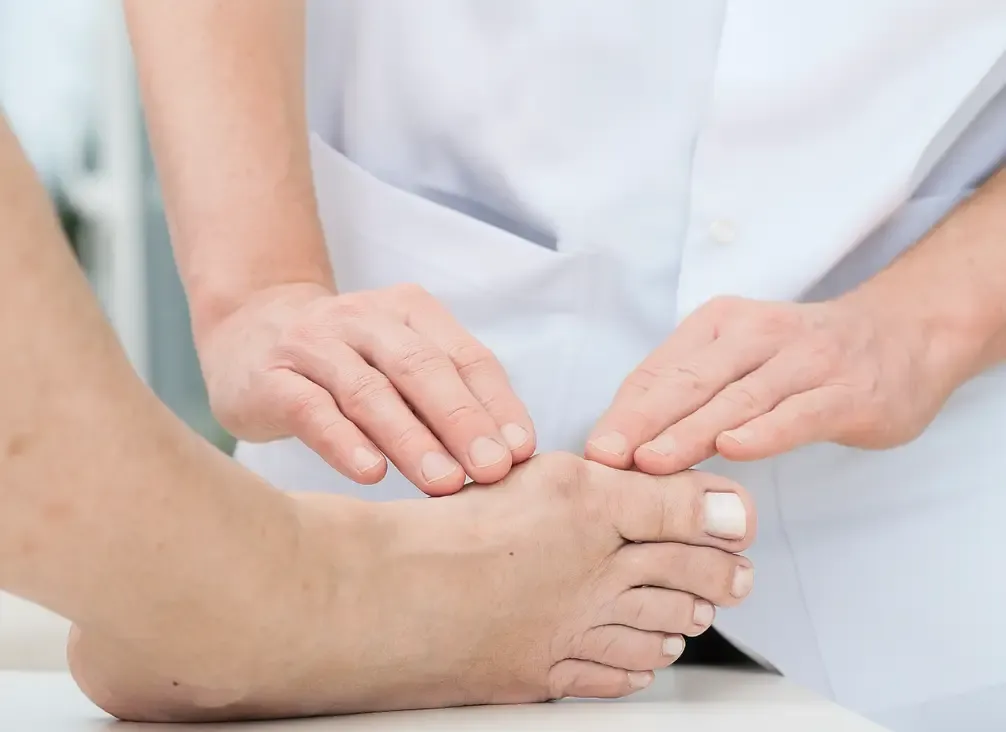
A bunion — hallux valgus — is what happens when the big toe gradually angles towards the second toe and the joint at its base pushes outward. The bump is the joint, not a growth on it.
They tend to get worse over years rather than months, and they can eventually affect what shoes you can wear and how comfortably you walk.
What causes them
Not one thing. A bunion is usually the result of several factors together:
- Inherited foot structure — the largest single factor
- Flat feet or foot mechanics that load the big toe joint abnormally
- Narrow shoes, high heels, and unsupportive footwear
- Joint hypermobility or lax ligaments
- Arthritis and inflammatory joint conditions
- Repetitive stress through the forefoot
Working out which apply matters, because it determines what’s worth changing.
What conservative care can do — and what it can’t
It’s worth being direct about this. Non-surgical treatment does not straighten a bunion. No exercise, splint, spacer or orthotic realigns the bone in an adult foot.
What it does do, and does well:
- Reduce pain in and around the joint
- Take pressure off the bump so footwear stops aggravating it
- Maintain movement in the joint, which is what keeps walking comfortable
- Address the mechanics that are driving progression
- Delay or avoid the point where surgery becomes the reasonable option
For most people that’s the goal, and it’s achievable.
How it’s approached
First, settle the symptoms. Padding and bunion guards to protect the joint, taping or bracing where useful, and strategies to reduce inflammation around the joint.
Then assess the mechanics. A biomechanical and gait assessment shows how your foot is loading and what’s driving the deviation. This is what separates treating the bump from treating the cause.
Then change the load. Footwear is usually the single highest-value change — adequate width and depth in the toe box, and a stable sole. Orthotics where the assessment shows they’d help redistribute forefoot pressure.
Then keep the joint moving. Mobility and strengthening work for the big toe joint and the foot, so the joint doesn’t stiffen as the deformity progresses.
Then review. Bunions change slowly, and the plan is adjusted as they do.
When surgery enters the conversation
Your podiatrist will raise it when:
- Pain persists despite proper conservative management
- No shoe is comfortable any more
- The second toe is being pushed out of position, or crossing over
- The joint is stiffening significantly
At that point you’d be referred to a foot and ankle surgeon for an opinion. Podiatry care continues alongside that either way — including before and after an operation, if you have one.
Frequently asked questions
Can a podiatrist get rid of my bunion?
No. Straightening the joint is surgery, and nothing non-surgical reverses the bony change. What conservative care does is reduce the pain, keep the joint moving, take pressure off the bump, and slow progression. For most people that's enough to stay comfortable and active without an operation.
Do bunion correctors work?
Night splints and toe spacers can ease symptoms and help maintain movement in the joint. They don't realign the bone in an adult foot, whatever the packaging says. Used for comfort and mobility they're reasonable; bought as a cure they're a disappointment.
Will I need surgery?
Most people don't. Surgery is considered when pain persists despite proper conservative care, when the deformity stops you wearing any shoe comfortably, or when the second toe is being pushed out of position. Your podiatrist will tell you if you're at that point and refer you to a surgeon for the conversation.
Did tight shoes cause this?
They contributed, probably, but the main driver is usually inherited foot structure and how your foot moves. Narrow shoes and high heels accelerate a bunion in a foot already predisposed to one — they rarely create one from nothing.
It doesn't hurt. Should I do anything?
It's worth an assessment even so. A painless bunion that's progressing is easier to manage now than once it's symptomatic, and the footwear and mechanical changes that slow it are simple.
Ready to book?
Appointments Monday to Saturday, with confirmation by SMS.