
Conditions
Achilles Tendon Pain
Reviewed by Anureet Selach, Podiatrist · Australian Podiatry Association · Registered with AHPRA
Last updated
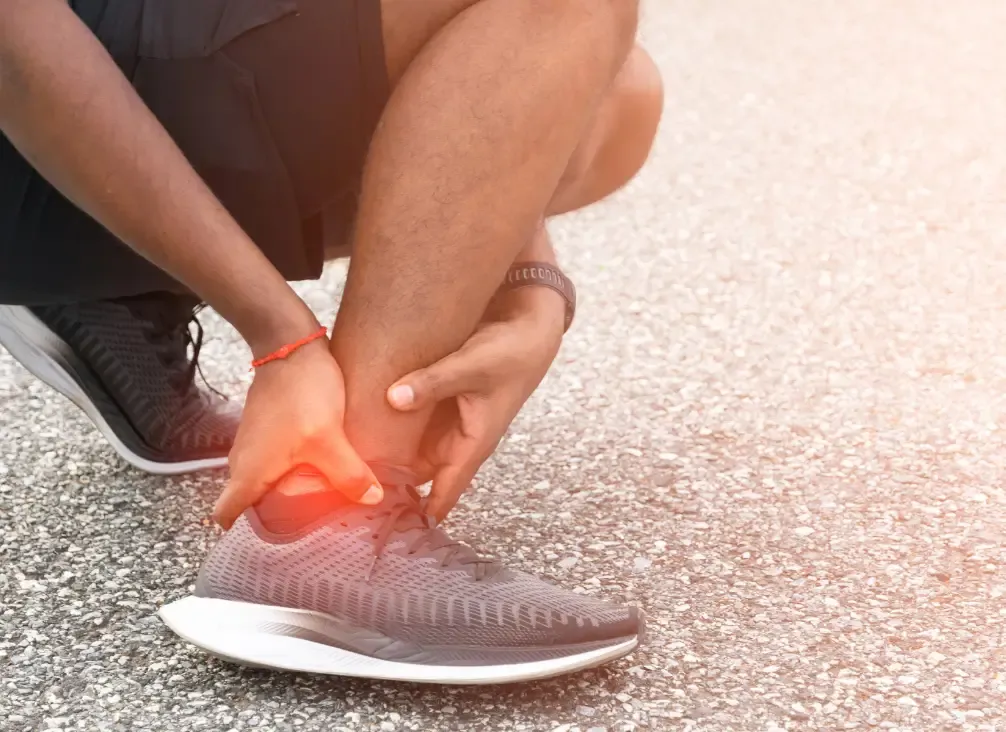
Stiffness at the back of the heel when you get up. A pulling or sharp pain above the heel bone that eases as you warm up and comes back afterwards. Tenderness if you squeeze the tendon.
That’s Achilles tendinopathy, and it’s one of the most common overuse injuries in active people and in anyone who spends long hours standing.
What it is
The Achilles is the strong tendon connecting your calf muscles to your heel bone. Under repeated strain it becomes irritated and, over time, the tendon tissue itself changes — microtears and disorganised collagen rather than clean, aligned fibres.
Typical signs:
- Swelling, thickening or tenderness just above the heel
- Morning stiffness, or stiffness after sitting
- Pain walking, running, or going up stairs
- A tendon that warms up and then hurts more later
It builds up gradually rather than arriving with a single injury, which is why it’s often well established by the time people come in.
What causes it
Usually several things at once:
- Overuse — running, jumping, or long periods standing
- A jump in training load without the conditioning to match
- Tight calf muscles, or weakness through the calf, glutes and lower limb
- Foot mechanics that increase the load or the direction of pull on the tendon
- Worn-out or unsupportive footwear
Working out which of these apply to you is the point of the assessment. Treating the tendon without changing what’s loading it is how this becomes a two-year problem.
How podiatry approaches it
Your podiatrist assesses the whole lower limb rather than just the sore tendon — foot mechanics, calf strength and length, gait, and how load is being distributed.
Treatment usually centres on:
- A graded loading programme. This is the core of it and the part with the best evidence. Progressive, specific strengthening that rebuilds the tendon’s capacity.
- Load management — adjusting volume, surface, pace and frequency so the tendon is challenged without being overwhelmed.
- Hands-on treatment for the calf and surrounding tissue.
- Footwear changes, sometimes with a temporary heel raise to reduce the pull while symptoms settle.
- Shockwave therapy for chronic cases that haven’t responded to loading — this is one of its clearest indications.
- Orthotics where mechanics are contributing.
- A CAM boot in the more severe or acute presentations, where the tendon needs offloading before anything else.
Give it time
Tendons adapt slowly. Three to six months is normal for something that’s been present for a while, and the most common reason it comes back is stopping the programme when the pain settles rather than when the tendon has actually rebuilt.
Get seen urgently if
You felt a sudden snap or a sensation like being kicked in the back of the ankle, and you can’t push off properly or stand on tiptoe. That may be a rupture and needs assessment straight away, not a routine booking.
Frequently asked questions
Is it tendinitis or tendinopathy?
Tendinopathy, almost always. The old name assumed inflammation, and what's usually found in a tendon that's been sore for more than a few weeks is degenerative change in the collagen rather than an inflammatory process. It matters because it changes the treatment — anti-inflammatories do comparatively little, and progressive loading does the work.
Should I stretch it?
Careful calf stretching helps some people and irritates others, particularly where the painful part is right at the heel bone. Loading — controlled, progressive strengthening — is the part with the strongest evidence behind it. Your podiatrist will tell you which applies to your presentation.
How long will it take?
Three to six months is a realistic range for a tendinopathy that's been present a while. Tendons adapt slowly. The programme is the treatment, and stopping when the pain settles at week six is the most common reason it returns.
Can I keep running?
Often yes, at reduced volume. Complete rest deconditions the tendon, and a deconditioned tendon is exactly what got sore in the first place. Your podiatrist will set what you can do while it settles rather than telling you to stop.
When is it something more serious?
Sudden severe pain with a snap or a feeling of being kicked in the back of the ankle, and difficulty pushing off or standing on tiptoe, can indicate a tendon rupture. That needs to be assessed urgently rather than at a routine appointment.
Ready to book?
Appointments Monday to Saturday, with confirmation by SMS.