
Services
What is a CAM Boot Walker?
Reviewed by Anureet Selach, Podiatrist · Australian Podiatry Association · Registered with AHPRA
Last updated
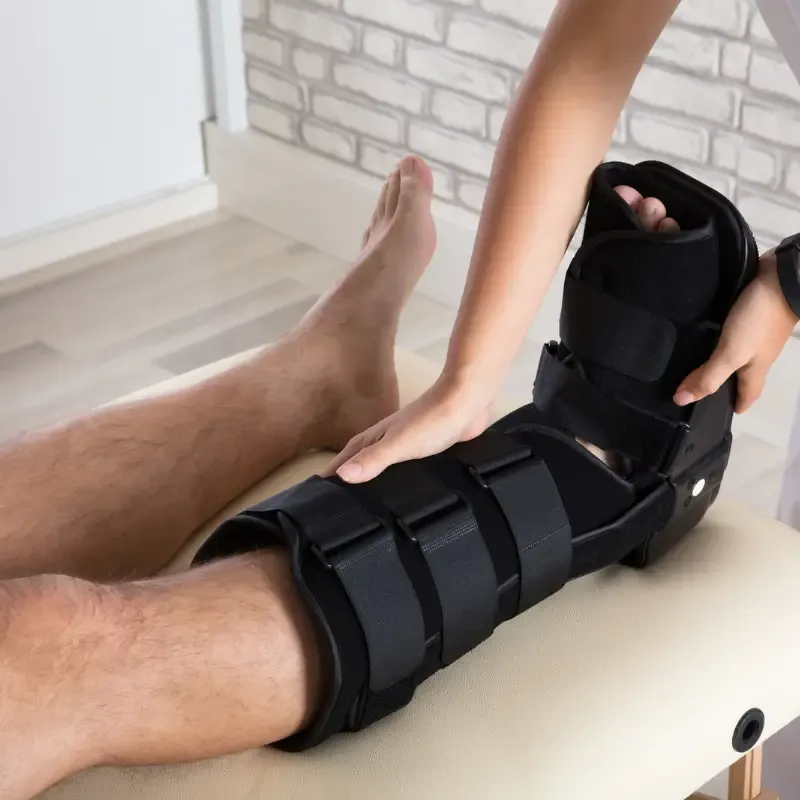
A CAM boot — Controlled Ankle Motion boot, moon boot, walker boot — is a medical-grade orthopaedic device that immobilises and protects the foot and ankle while still letting you bear some weight. It holds the injured part still enough to heal without the total restriction of a plaster cast.
The curved rocker sole is what lets you walk in it. It rolls you through the step so the foot and ankle don’t have to.
When one is used
CAM boots are commonly prescribed for:
- Stress fractures and non-displaced fractures
- Ligament sprains and soft tissue injuries
- Achilles tendon injuries
- Recovery after foot or ankle surgery
- Severe heel pain or plantar fasciitis that hasn’t responded to other treatment
- Coming back to walking gradually after an injury
Why a boot rather than a cast
- It comes off — for showering, for sleeping if your injury allows it, and for checking the skin underneath.
- It’s lighter, and easier to manage day to day.
- The lining is washable, which matters over six or eight weeks.
- Air compression in high-top models adds stability.
- And you can reach an itch, which sounds trivial until week three.
Why fitting is a clinical job
Sizing and setup are the whole difference between a boot that protects an injury and one that creates a second problem. At a fitting your podiatrist will work out:
- Short boot or tall boot, based on what’s injured
- Correct size — a boot that’s too small puts pressure on the toes, one that’s too big is a trip hazard
- How to walk in it, manage stairs, and how you’ll come out of it later
- Whether you also need crutches, an Achilles wedge, or a shoe balancer
A shoe balancer is the accessory most people underestimate. The boot is taller than your other shoe, so without one you’re walking with a leg-length difference every step. That’s the usual reason someone develops hip or lower back pain that they didn’t have before the injury.
Watch for calf symptoms
Reduced mobility raises the risk of deep vein thrombosis, and a boot that holds the ankle still reduces the calf-muscle pumping that normally keeps blood moving. New or worsening calf pain, throbbing, tightness, redness, swelling or unusual warmth needs same-day medical attention.
This is covered properly, along with everything else about living in a boot, in the CAM boot guide.
Accessories
- Achilles wedge kit — steps the heel angle down gradually through recovery
- Shoe lift balancer — evens leg length, prevents the limp and the back strain
- Ergonomic forearm crutches — for non- or partial weight-bearing stages
- Seamless boot socks — reduce the friction that causes blisters under a liner
All available in the shop.
Fees and health fund claiming
The boot is $115 (item 201) and the fitting is $78 (item 414). Most extras policies cover both. Quote the item codes to your fund for your rebate, or claim on the spot through HICAPS and pay the gap.
Consultation fees are separate and are listed in full on fees and rebates.
Frequently asked questions
What does a CAM boot cost?
The boot itself is $115 (item 201) and the fitting is $78 (item 414). Accessories are priced separately — a shoe lift balancer, an Achilles wedge kit or crutches, depending on what your injury needs. Full list on the fees page.
Do I need a referral?
No. You can book a fitting directly. Bring any imaging or a specialist letter if you have them, because they change which boot and which height is appropriate.
Can't I just buy one online?
You can, and people do. The problem is that a boot which is the wrong size or wrongly strapped can cause pressure sores, delay healing, and set off hip and back pain from the leg-length difference. If you've already bought one, book a fitting and bring it in — your podiatrist will check the size and set it up properly.
Short boot or tall boot?
That's determined by what's injured and how much control it needs. A tall boot controls the ankle as well as the foot; a short one doesn't. It's one of the things the fitting appointment decides, and it isn't a preference question.
How do I actually use it day to day?
There's a full guide to fitting it, walking in it, stairs, hygiene and what to watch for on our CAM boot guide.
Ready to book?
Appointments Monday to Saturday, with confirmation by SMS.