
Conditions
Hammer Toes
Reviewed by Anureet Selach, Podiatrist · Australian Podiatry Association · Registered with AHPRA
Last updated
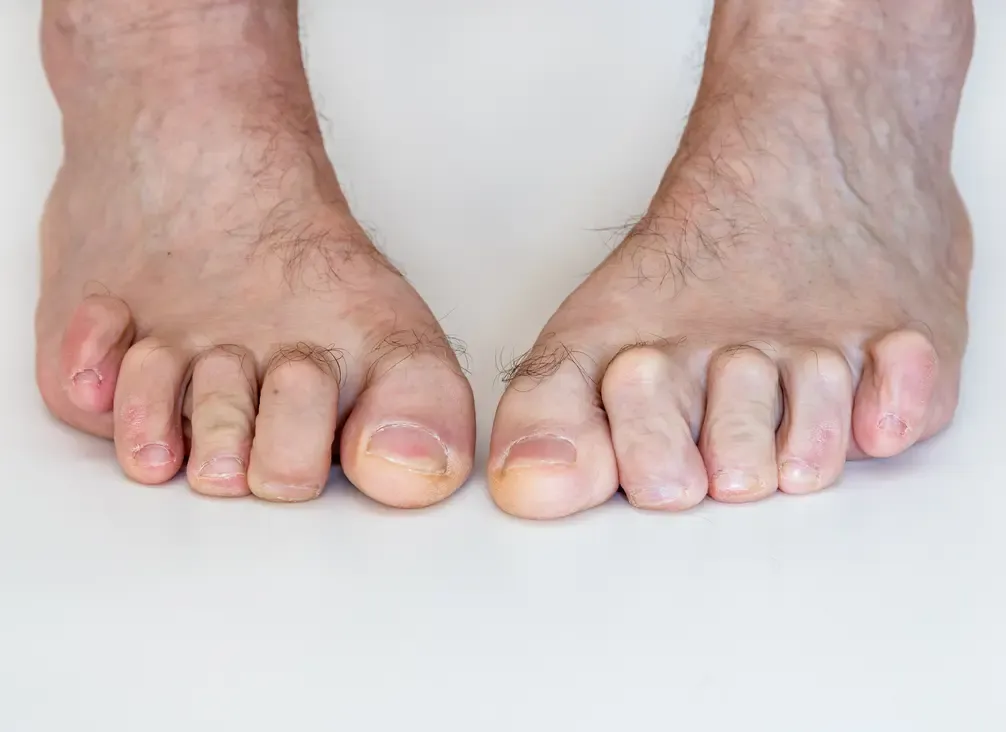
A toe that sits bent and no longer lies flat. A corn on the top of it where it meets the shoe, or on the tip where it presses into the sole. A callus under the ball of the foot behind it.
Which joint has bent
The three names describe the same process at different joints, and they overlap:
- Hammer toe — bent at the middle joint of the toe, so the toe humps upward. The most common.
- Mallet toe — bent at the joint nearest the nail, so the tip curls down and the pressure lands on the end of the toe.
- Claw toe — bent at both, and pulled upward at the base as well. Often affects several toes, and is more commonly linked to a neurological cause.
The second toe is affected most often, usually because a bunion has pushed the big toe across into it.
Flexible or fixed, and why it is the important question
Early on, the toe is flexible: it stays bent when you stand but you can straighten it with your fingers. This is the stage where treatment has the most to work with — the joint is not yet stuck, and keeping it moving, offloading it and changing the pressure can hold things where they are.
Left long enough, the joint capsule and the tendons tighten and the toe becomes fixed. It no longer straightens, and no amount of padding, splinting or footwear will make it. Everything at that point is about managing pressure and comfort rather than position, and correcting it means surgery.
The transition is gradual and usually painless, which is why so many people arrive when it has already happened.
What causes it
- Muscle imbalance. The commonest driver: the long tendons that bend the toe overpower the small muscles that keep it straight, and the toe buckles.
- A bunion, crowding the toe beside it.
- Toe length. A second toe longer than the big toe has to bend to fit.
- Footwear that is short or shallow, held over years.
- A high-arched foot, which loads the toes differently.
- Neurological conditions — diabetes with neuropathy, Charcot-Marie-Tooth and others — which change how the small muscles of the foot work. Claw toes developing across several toes at once warrant this being considered.
- Rheumatoid arthritis and other inflammatory joint disease.
Treatment
While the toe is flexible: keeping it moving with toe mobility and intrinsic foot strengthening, silicone splints or crest pads to hold a better position and take the pressure off the tip, and footwear with a deep, roomy toe box. That last one does more work than anything else on the list.
Whatever the stage, the pressure has to be managed. That means reducing the corn or callus that has formed, and then changing what is causing it — padding, a silicone device made to the toe, or an orthotic where the forefoot loading behind the toe is part of the picture.
Where the toe is fixed, painful, and not manageable with footwear and offloading, your podiatrist will discuss referral for a surgical opinion.
⚠ If you have diabetes or reduced sensation, a hammer toe is a pressure point on a foot that cannot feel pressure. Corns on the top and tip of a clawed toe are among the most common sites for a diabetic foot ulcer. Have it assessed rather than padded at home — see diabetic foot care.
Frequently asked questions
Can a hammer toe be straightened without surgery?
While the toe is still flexible — meaning you can straighten it with your fingers — a great deal can be done to keep it flexible, offload it and stop the corn that comes with it. What conservative treatment does not do is permanently restore a toe that has become fixed. That is the practical reason for having it looked at early rather than when it stops bending.
Why do I keep getting a corn on top of that toe?
Because the buckled joint is now the highest point of the foot and it presses against the top of the shoe with every step. The corn is the skin's response to that pressure. Removing the corn without changing the pressure means it comes back, which is why the appointment is about the shoe and the toe, not only the skin.
What is the difference between a hammer toe, a claw toe and a mallet toe?
Which joint is bent. A hammer toe bends at the middle joint. A mallet toe bends at the joint nearest the nail. A claw toe bends at both, and the toe knuckles up at the base as well. They overlap in cause and in treatment, and the distinction mostly matters for where the pressure lands.
Are my shoes causing it?
Footwear that is too short or too shallow holds the toes in a bent position, and over years that contributes. But it is rarely the whole story — muscle imbalance, a long second toe, a bunion pushing across, and neurological conditions all drive it. Blaming the shoes alone tends to mean the real driver goes unaddressed.
Is it connected to my bunion?
Often, yes. A bunion pushes the big toe across into the second toe, which then has nowhere to go but up. That is why the second toe is the one that most commonly buckles, and why the two are frequently assessed together.
Ready to book?
Appointments Monday to Saturday, with confirmation by SMS.