
Conditions
Corns and Calluses
Reviewed by Anureet Selach, Podiatrist · Australian Podiatry Association · Registered with AHPRA
Last updated
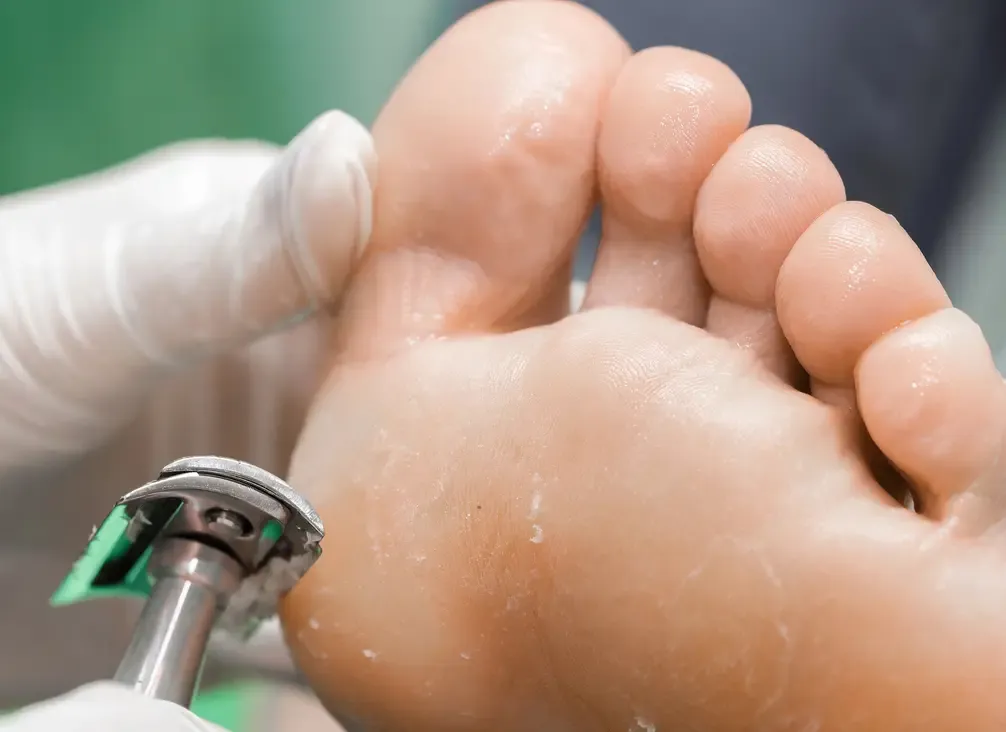
Hard, thickened skin under the ball of the foot or the heel. A small dense spot on a toe that feels like standing on a pebble. Skin that you have been filing for months and that keeps coming back.
Callus is not a skin disease. It is armour. Skin thickens where it is loaded repeatedly, exactly as it does on a guitarist’s fingertips, and it is doing what it is supposed to do. It becomes a problem when the thickening itself starts generating pressure, at which point the protective response has turned into the source of the pain.
Corns and calluses are the same process at different scales
Callus is diffuse — a broad plaque of thickened skin over an area that takes more load than it was built for. It is usually painless at first and turns achy or burning as it deepens.
A corn is that same process concentrated into a small area. The thickening develops a dense central core that presses inward rather than outward, which is what produces the sharp, localised, standing-on-a-stone feeling. Corns turn up on the tops of toes, the tips of toes, between toes where two bones squeeze skin between them, and occasionally under the ball of the foot.
What is actually causing it
The hard skin is the visible end of a mechanical chain, and the chain is what an appointment is for:
- Footwear. Too short, too shallow in the toe box, too loose so the foot slides, or a seam sitting across a toe.
- Toe position. A hammer toe buckles a joint upward into the shoe, so a corn forms on top of it. A bunion pushes the first toe across and loads the joint beside it.
- How you distribute weight. A foot that pronates heavily, a stiff big toe, or a dropped metatarsal head all concentrate load onto one small area.
- Loss of the fat pad. The cushioning under the ball of the foot thins with age, which is why forefoot callus is far more common after sixty.
- Dry skin. Not a cause on its own, but dry callus splits, and a split in a weight-bearing surface is a route in for infection.
What happens at the appointment
Your podiatrist reduces the callus or enucleates the corn with a sterile scalpel. It is not painful — the tissue being removed has no nerve supply — and the pressure relief is usually immediate and obvious.
That is the quick part. The rest of the appointment is the part that decides whether you are back in eight weeks:
- Where the load is going, assessed standing and walking
- Your footwear, which is why bringing the shoes you actually wear matters
- Toe position and joint range
- Skin condition, circulation and sensation, particularly if you have diabetes
From there the options are padding or silicone devices to redistribute pressure, footwear changes, orthotics where the loading pattern is the driver, and a maintenance interval that suits how fast your skin rebuilds.
When hard skin is not a routine problem
⚠ If you have diabetes, peripheral neuropathy or poor circulation, callus is not cosmetic. Thickened skin over a pressure point is the single most reliable warning sign that precedes a foot ulcer, because the tissue underneath is being damaged before the surface breaks. It is also the point where self-treatment does the most harm.
Book a diabetic foot assessment rather than filing it, and never use acid corn plasters.
Anything that bleeds, discharges, smells, or is surrounded by red or warm skin needs looking at promptly rather than at the next convenient appointment.
A note on what a corn is not
Two things get mistaken for corns often enough to be worth naming.
A plantar wart is viral, not mechanical. It is painful pinched side to side rather than pressed straight down, often shows tiny dark points, and interrupts the skin lines rather than following them.
A foreign body — a splinter, a grass seed, a fragment of glass — produces a tender lump with callus built over it. Both are treated completely differently from a corn, which is the practical reason for having someone look at it rather than working on it yourself.
Frequently asked questions
Does having a corn cut out hurt?
No. Callus and corn tissue has no nerve supply, so a podiatrist reducing it with a scalpel is closer to having a nail cut than to a procedure. Most people find the pressure relief immediate. If something hurts during it, say so, because that means the blade has reached living tissue and your podiatrist will stop.
Why does it keep coming back?
Because removing hard skin treats the symptom. The skin thickened for a reason: something is loading that spot harder than the rest of the foot, usually a footwear fit, a toe position, or the way you distribute weight. Unless that changes, the skin does exactly what it did before. This is why the assessment matters more than the removal.
Can I use corn plasters from the chemist?
Be careful with the medicated ones. Most work by applying salicylic acid, which does not distinguish between hard skin and the healthy skin around it, and a burn under a plaster on someone with diabetes or poor circulation is a serious problem. If you have either, do not use them at all — see a podiatrist instead.
What is the difference between a corn and a callus?
A callus is a broad area of thickened skin spread over a pressure area. A corn is concentrated: a small, dense core pressing inward, which is why it feels like standing on a stone. Corns are usually the more painful of the two for that reason.
Can I just file it myself?
Gentle filing of a callus with a pumice or foot file after a shower is reasonable maintenance. What is not reasonable is cutting at it with a blade or a razor at home, which is the most common way people arrive here with an infected foot.
Ready to book?
Appointments Monday to Saturday, with confirmation by SMS.