
Conditions
Heel Spurs
Reviewed by Anureet Selach, Podiatrist · Australian Podiatry Association · Registered with AHPRA
Last updated
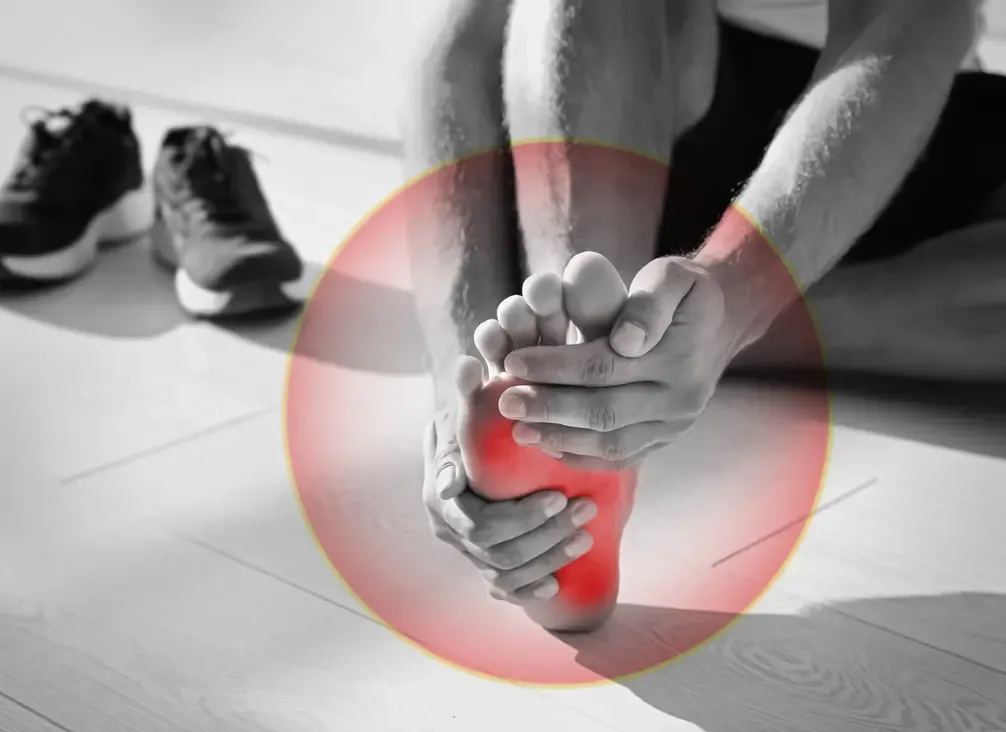
You had an X-ray for heel pain and it showed a spur. That felt like an answer.
It usually is not one, and understanding why changes what happens next.
What a heel spur is
A heel spur is a small outgrowth of bone at the underside of the heel, at the point where the plantar fascia attaches. It develops slowly, over years, in response to sustained traction and load at that attachment.
It is a consequence of long-term loading, not a cause of pain. Spurs are found routinely on X-rays of people with entirely comfortable feet, and a great many people with genuinely disabling heel pain have no spur at all. The correlation between having a spur and having symptoms is weak.
What makes the spur so persuasive is geography: it forms at exactly the site that hurts, because both are the plantar fascia’s attachment.
So what is actually causing the heel pain
In most cases, one of these:
Plantar fasciitis — irritation at the fascia’s attachment. Sharp pain on the first steps of the morning or after sitting, easing as you move, returning after a long day. This is the most common answer by a distance.
Fat pad irritation, or a bruised heel — the cushioning under the heel bone damaged by a heavy landing or ground down by long periods on hard surfaces. The pain sits in the centre of the heel and gets worse the longer you are on it, rather than being worst on the first step.
Baxter’s nerve entrapment — a nerve compressed near the inside of the heel. Often mistaken for stubborn plantar fasciitis, and suspected when there is burning or tingling, or when the pain does not follow the classic first-step pattern.
A calcaneal stress fracture — uncommon, but important. Pain on squeezing the heel bone from both sides, worse with impact, following a genuine increase in load.
In children, Sever’s disease — heel pain at the growth plate, and never a spur.
What the assessment is doing
Distinguishing between those, because they are treated differently and the X-ray does not do it for you.
Your podiatrist will locate the tenderness precisely, test the fascia, assess calf length and big toe range — both drive load into the heel — check foot posture standing and moving, and go through what changed before it started.
Treatment
Aimed at the irritated tissue, not the bone. For the fascial cases that is load management, a calf and foot loading programme, footwear, orthotics where mechanics are driving it, and shockwave therapy for cases that have not responded to several months of conservative treatment.
Fat pad problems are managed with cushioning and offloading rather than stretching, which is one practical reason for telling them apart.
⚠ A spur being visible does not change any of that, and it is worth saying plainly: people are regularly told they need surgery for a spur when the spur was never the problem. If your heel pain resolves and the spur is still on the X-ray, nothing has gone wrong.
Frequently asked questions
My X-ray shows a heel spur. Is that what is causing the pain?
Usually not, and this is the most useful thing on the page. Heel spurs are found in a substantial proportion of people who have never had heel pain in their lives, and plenty of people with severe heel pain have no spur at all. The spur is generally a marker that the area has been under load for a long time, not the structure generating the symptoms.
Does the spur need to be removed?
Very rarely. Surgery to remove a spur is not the standard approach to heel pain, because the spur is usually incidental. Treatment is directed at the tissue that is actually irritated, which in most cases is the plantar fascia or the fat pad.
Then why does it hurt exactly where the spur is?
Because the spur forms at the point where the plantar fascia attaches to the heel bone, and that attachment is precisely the site that gets irritated. Both things are at the same address. That coincidence is why the spur got the blame for decades.
Can a spur go away?
The bony growth itself does not resolve. The pain generally does, with treatment aimed at the soft tissue. People are often surprised that their heel stops hurting while the X-ray looks exactly the same, which is the clearest demonstration that the spur was not the problem.
What about a bruised heel?
Different problem, similar location. A bruised heel is an injury to the fat pad under the heel bone, usually from a heavy landing or from long periods on hard surfaces. It hurts in the centre of the heel rather than at the front edge, and it is worse the longer you are on it rather than worst on the first steps of the day.
Ready to book?
Appointments Monday to Saturday, with confirmation by SMS.